
Stop Invoice Fraud
Before Payments Leave
Attackers register domains that look identical to your trusted vendors — then send convincing invoices with updated banking details. By the time finance discovers the fraud, the money is gone.
DefendDomain detects fake vendor domains the moment they appear, alerting your team before a single fraudulent invoice is processed.
The FBI reported $2.9 billion in BEC losses in 2023 alone, with the average incident costing $137,000. And 79% of organisations experienced payment fraud in 2024.
We catch the fake vendor domains before fraudulent invoices are ever sent.
DefendDomain monitors for lookalike domains mimicking your company and your critical vendors. When an attacker registers a domain designed to impersonate a trusted supplier, your finance and security teams are alerted immediately — with full evidence to verify the threat.
Understanding the threat
What Is Vendor Invoice Fraud?
Vendor invoice fraud — also called supplier email compromise or mandate fraud — occurs when attackers impersonate a trusted vendor to redirect payments. They register a lookalike domain, send a convincing email requesting updated banking details, and wait for finance to process the change.
Internal BEC
Attackers spoof an executive's email to request urgent wire transfers. Caught by DMARC when properly configured.
Mitigated by DMARC and email authentication.
Inbound Payment Requests
Fraudulent payment requests sent to your accounts payable team from external senders.
Partially caught by email gateways.
Vendor Domain Impersonation
Attackers register domains nearly identical to your trusted vendors (e.g., supp1ier-corp.com vs supplier-corp.com) and send invoices with updated banking details that bypass all email filters.
We detect fake vendor domains the moment they register, before any fraudulent invoice is sent.
Real-World Invoice Fraud Threats We Detect
These are the attacks targeting finance teams right now. DefendDomain catches the domain infrastructure behind each one.

 Phishing, Fraud
Business Email Compromise (BEC) & CEO Fraud
Attackers impersonate a senior executive to transfer funds to their account.
Who Benefits from Vendor Domain Monitoring
Invoice fraud sits at the intersection of security, finance, and procurement. Each team has a different reason to act.
CFOs & Finance Directors
Proactive protection for accounts payable
Early warning when domains impersonating your vendors appear. Your finance team is alerted before any fraudulent invoice reaches accounts payable.

CISOs & Security Leaders
Quantifiable reduction in financial fraud risk
Board-level reporting on vendor impersonation threats detected. Demonstrate that financial fraud prevention extends to the external perimeter.

IT Directors & Heads of Risk
Automated vendor domain monitoring at scale
No manual domain checks. Threats arrive pre-triaged with WHOIS, DNS, and risk scores — your team acts only on confirmed threats.

Procurement & Vendor Management
Protect supply chain relationships
Monitor your critical vendor domains for impersonation. Know immediately when attackers register domains designed to mimic your suppliers.

Common assumptions
Why Your Payment Controls Still Have Gaps
Dual authorisation, callback procedures, and trained finance teams are essential. But sophisticated attackers have adapted to every one of these controls.
"We verify payment changes by phone"
Attackers anticipate callback procedures. They register lookalike domains, set up convincing email threads over days or weeks, and time their requests for high-pressure moments — month-end, quarter-close, or during a key project. Under time pressure, callbacks get skipped or directed to the wrong number.
Why verification alone isn't enough"Dual authorisation protects us"
Dual authorisation ensures two people approve a payment — but if both approvers see the same convincing email from what appears to be a trusted vendor’s domain, they’ll both approve it. The control validates process, not authenticity of the request.
Gaps in dual authorisation"Our bank will reverse fraudulent transfers"
Banks can only reverse transfers that haven’t been withdrawn. Attackers move stolen funds within hours, often through multiple accounts across jurisdictions. In 2024, less than a quarter of organisations recovered 75% or more of funds lost to payment fraud (AFP Survey).
Why recovery is unreliable"We trust our established vendors"
That trust is exactly what attackers exploit. Long-standing vendor relationships create familiarity that makes finance teams less likely to question routine-looking invoices. Attackers study your vendor relationships through LinkedIn, press releases, and data breaches to craft perfect impersonations.
How attackers exploit vendor trustFive layers of protection
How DefendDomain Prevents Invoice Fraud
Every invoice fraud scheme starts with a fake domain. We detect the domain infrastructure before the first fraudulent email is sent, and check your own domains for the spoofable email settings that make BEC possible.
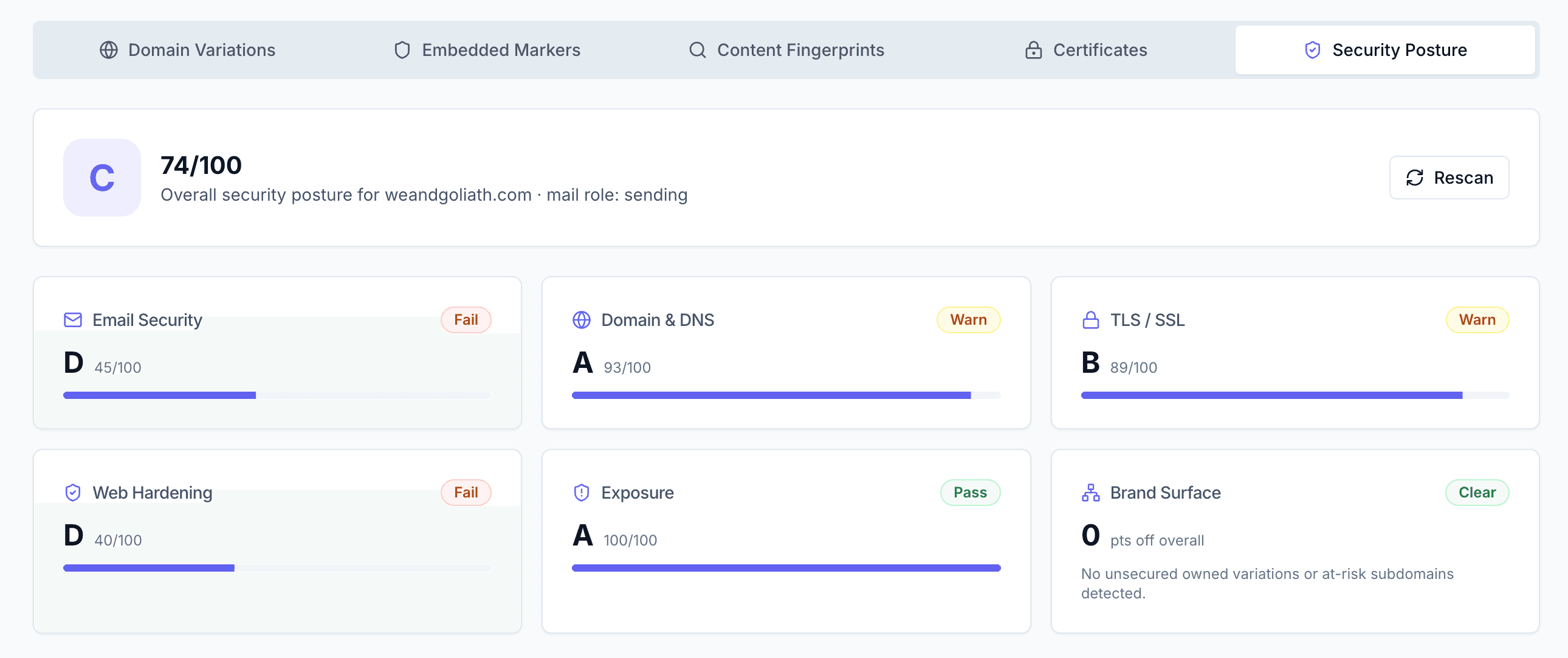
Layer 1
Domain Monitoring
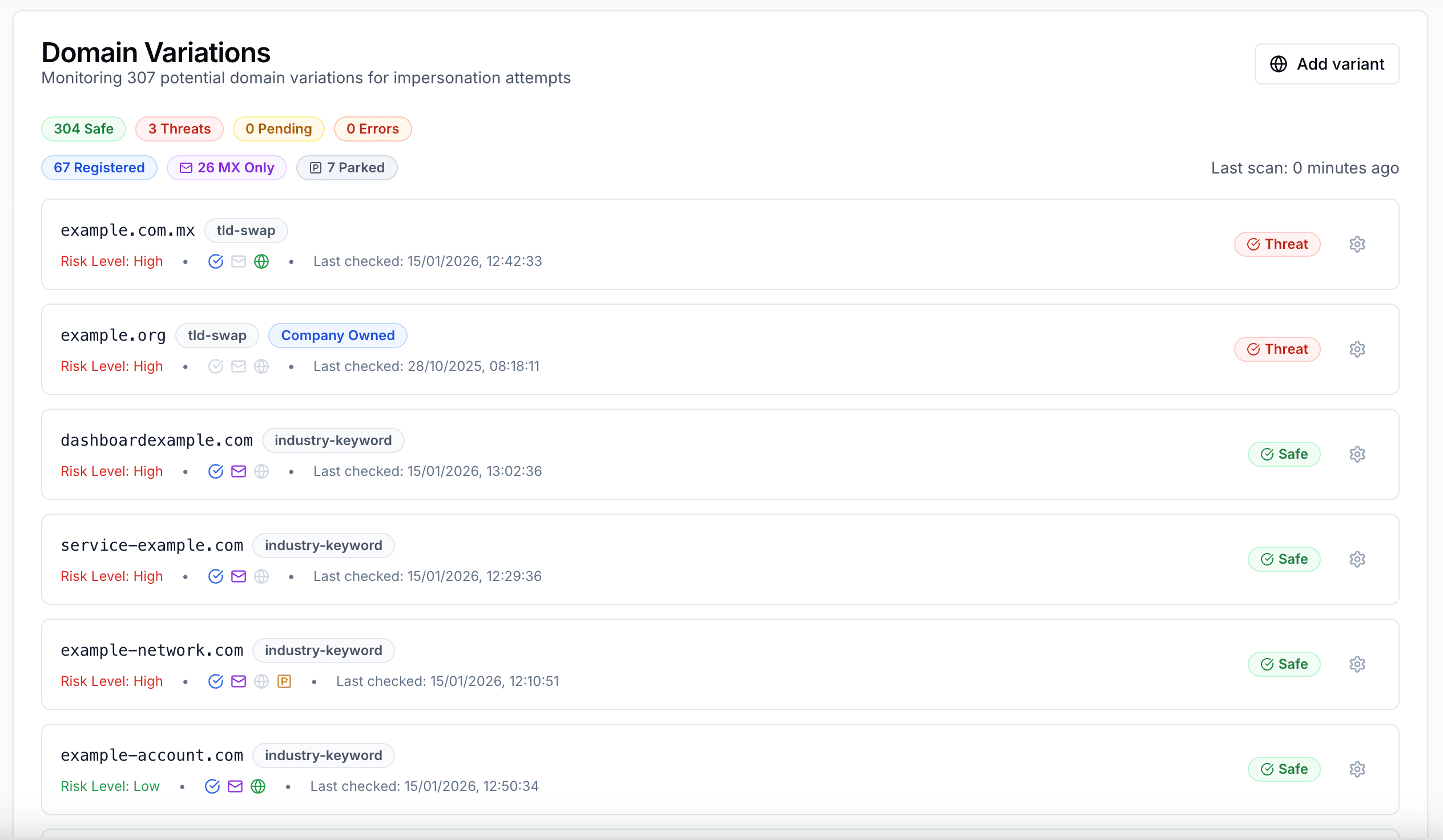
Proactively monitors for lookalike domains that could be used to impersonate your brand. Our AI generates thousands of domain variations including typos, homoglyphs, and keyword combinations, then continuously scans for registrations.
- Detects typosquatting and phishing domains
- Monitors domain registrations in real-time
- AI-powered threat scoring and prioritization
- Automated evidence collection for takedowns
See it in action
When We Detect a Vendor Impersonation, You Get Everything
Not just an alert — a full evidence package showing the fake domain, its registration details, DNS configuration, and visual comparison to the legitimate vendor.
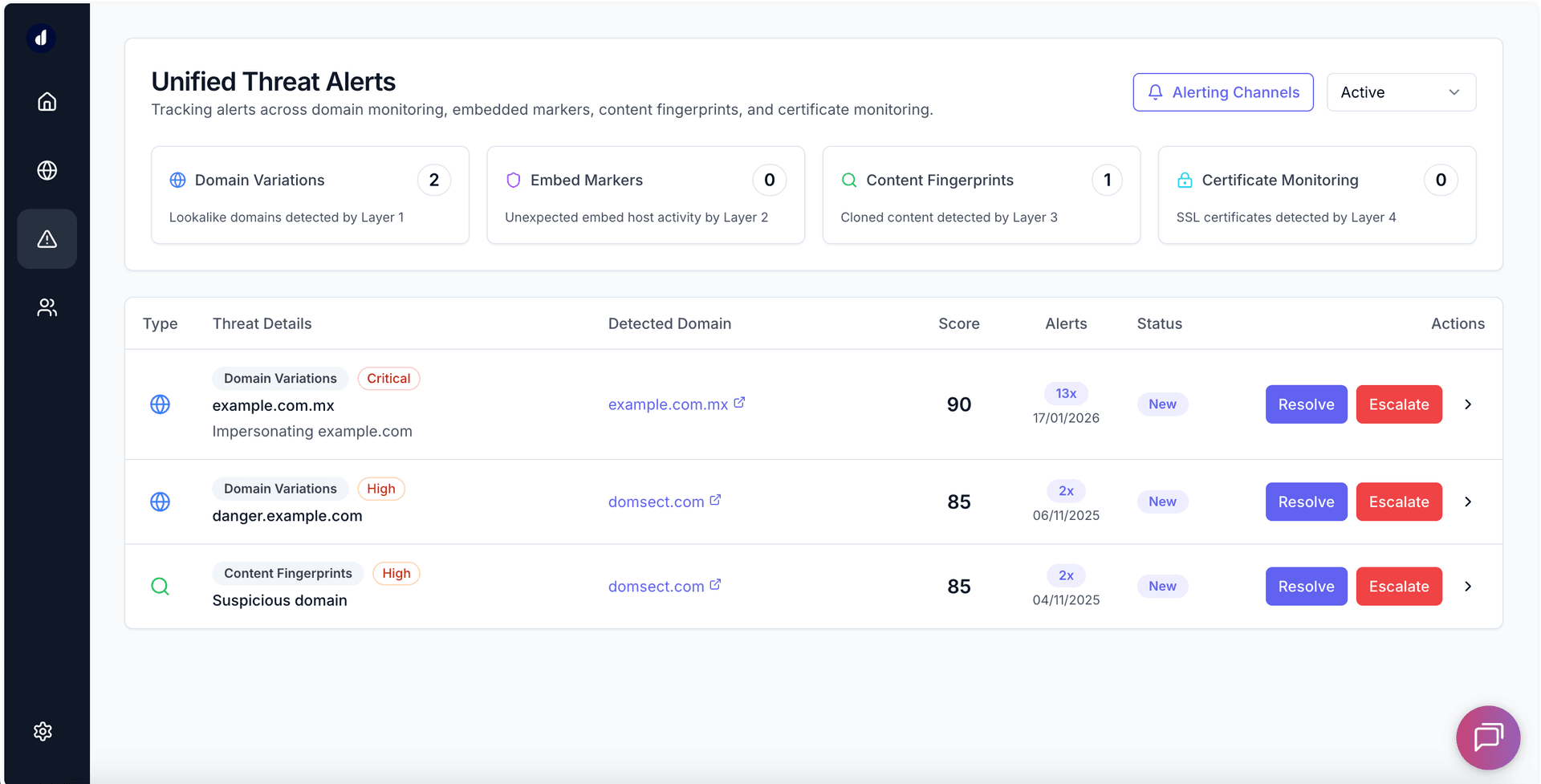
Unified Threat Dashboard
Every detected threat feeds into a single dashboard. Intelligent deduplication prevents alert fatigue, while threat lifecycle management tracks every incident from detection to resolution with a full audit trail.
One Pane of Glass
Filter by detection type, severity, and status
Intelligent Deduplication
Prevents repeated alerts with exponential backoff and smart grouping
Rich Evidence
Screenshots, WHOIS, DNS records, hosting info, and risk scoring — automatically compiled
Full Lifecycle Tracking
Six statuses from detection to resolution, with notes and a complete audit trail
Fits Into Your Existing Workflow
Alerts arrive wherever your team works. No new dashboard to monitor — threats flow directly into your existing tools.

Slack
Teams
Webhooks
SMS

Splunk HEC
Sentinel

Wazuh
RBAC & Team Collaboration
Role-based access control with System Admin, Threat Manager, and Security Observer roles.
Compliance Reports
ISO-ready reports, Certificate of Protection PDFs, and complete audit trails for regulators.
RESTful API
Programmatic access for custom integrations, automation, and extending your security workflows.
Industry Recognition
Our approach to proactive domain security has been recognized by leading industry bodies and cybersecurity experts.

Frequently Asked Questions
Common questions from finance and security leaders evaluating invoice fraud protection.
See DefendDomain in Action
Request a personalised demo and we'll show you how attackers could target your vendor relationships today. No obligation — just a clear picture of your exposure.

Speak with our team
We'll walk you through the platform and answer any questions about protecting your organisation.